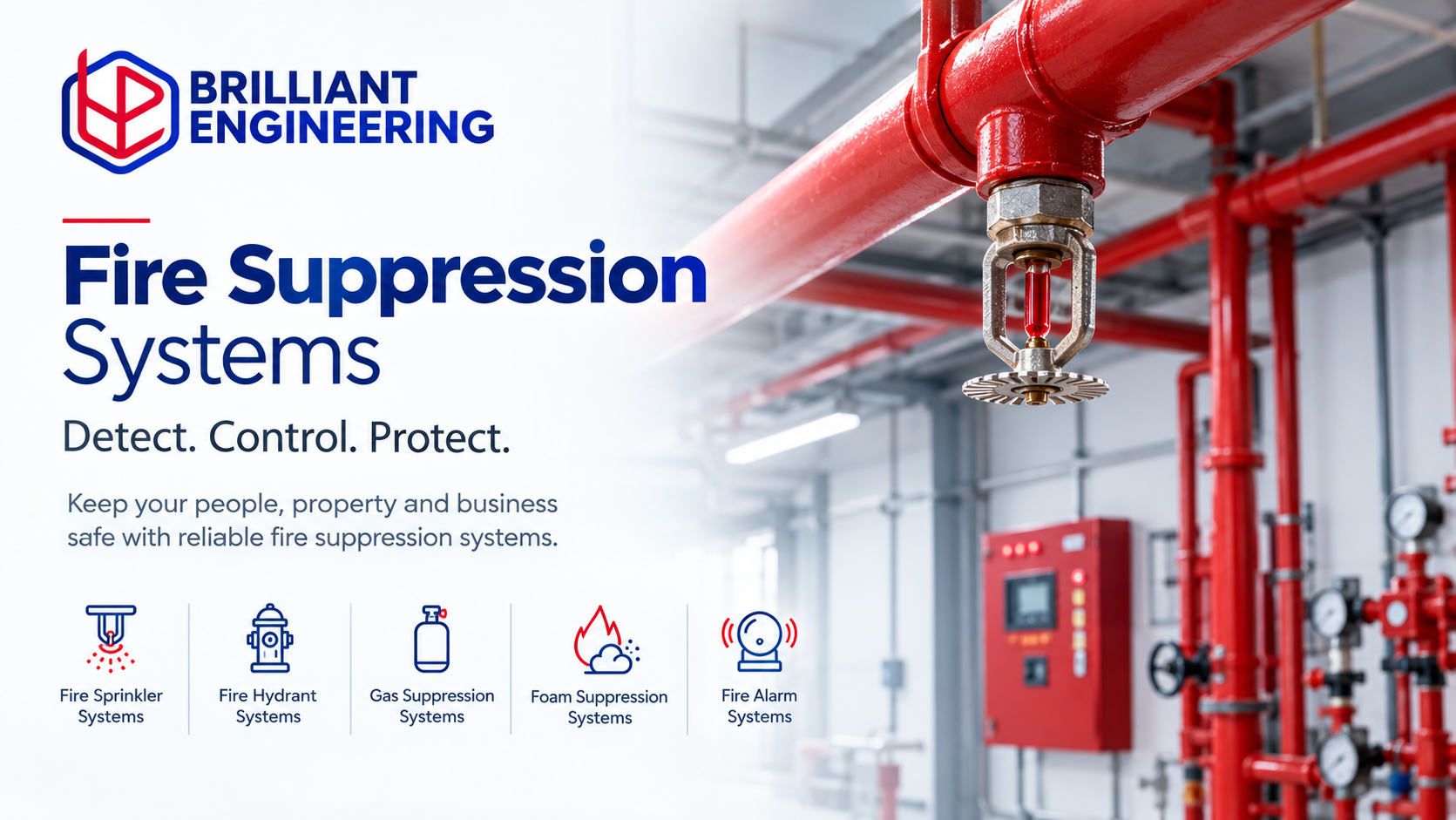
A fire suppression system is one of the most critical safety installations in any commercial or industrial building. It detects fires in their earliest stages and automatically activates to suppress or extinguish them — protecting lives, property, and business continuity.
At Brilliant Engineering, we design and install complete fire suppression systems that comply with NFPA standards and Egyptian Civil Defense requirements, across a wide range of commercial and industrial facilities.
What Is a Fire Suppression System?
A fire suppression system is a group of engineered components that work together to detect, control, and extinguish fires automatically — without requiring human intervention. Unlike portable fire extinguishers that depend on a person being present, a fire suppression system activates the moment it detects heat, smoke, or flame.
Modern fire suppression systems are designed to:
- Detect fires in their earliest stage — before they spread
- Automatically activate suppression agents to control the fire
- Alert occupants and emergency services simultaneously
- Minimize damage to property, equipment, and products
- Comply with local fire safety codes and insurance requirements
How Does a Fire Suppression System Work?
A fire suppression system follows a simple but highly reliable process:
Step 1 — Detection: Heat detectors, smoke detectors, or flame detectors continuously monitor the protected area. The moment a fire is detected, they send a signal to the control panel.
Step 2 — Alarm Activation: The fire alarm panel receives the signal and immediately activates audible and visual alarms throughout the building, alerting occupants to evacuate.
Step 3 — Suppression Activation: Depending on the system type, suppression agents are automatically released — either through sprinkler heads, gas discharge nozzles, or foam outlets — directly at the fire source.
Step 4 — Notification: The control panel simultaneously sends an alert to the Civil Defense monitoring center and the building management system.
Step 5 — Containment: The suppression agent controls or extinguishes the fire, preventing it from spreading to other areas of the building.
Types of Fire Suppression Systems
1. Water Sprinkler Systems
The most common type worldwide. A network of pipes pressurized with water, connected to sprinkler heads that activate individually when heat is detected. Only the sprinkler heads nearest to the fire activate — minimizing water damage to unaffected areas.
Best for: Office buildings, hotels, shopping malls, warehouses, hospitals.
2. Fire Hydrant Systems
A network of standpipe systems and hydrant outlets that provide firefighters with immediate access to high-pressure water throughout the building.
Best for: All building types — required by Egyptian Civil Defense in all commercial and industrial buildings above a certain size.
3. Gas Suppression Systems (Clean Agent)
Use non-conductive, non-corrosive gases such as FM-200, CO2, or Inergen to suppress fires without damaging sensitive equipment. The gas floods the protected space, removing the oxygen needed for combustion.
Best for: Server rooms, data centers, control rooms, electrical switchgear rooms, archives, and areas where water damage is unacceptable.
4. Foam Suppression Systems
Discharge a blanket of foam over flammable liquid fires, cutting off the oxygen supply and preventing re-ignition.
Best for: Fuel storage facilities, aircraft hangars, chemical plants, and petrochemical facilities.
5. Dry Chemical Suppression Systems
Use dry chemical powder agents to suppress fires quickly. Highly effective on Class B (flammable liquid) and Class C (electrical) fires.
Best for: Industrial kitchens, generator rooms, vehicle maintenance areas.
6. Smoke Extraction Systems
While not a suppression system, smoke extraction is a critical life-safety complement. Dedicated fans and ductwork remove toxic smoke from escape routes and stairwells, giving occupants more time to evacuate safely.
Best for: Underground car parks, enclosed shopping malls, high-rise buildings, and any building with enclosed escape routes.
Key Components of a Fire Suppression System
A complete fire suppression system consists of several interconnected components:
Detection Devices
- Smoke detectors — optical or ionization type
- Heat detectors — fixed temperature or rate-of-rise
- Flame detectors — detect infrared or ultraviolet radiation from flames
- Manual call points — allow occupants to manually trigger the alarm
Control and Signaling
- Fire alarm control panel (FACP) — the central brain of the system
- Addressable loop modules — identify the exact location of each detector
- Remote monitoring connection — links to Civil Defense monitoring center
Suppression Components
- Sprinkler heads — automatic or deluge type
- Hydrant outlets and landing valves
- Gas discharge nozzles and storage cylinders
- Foam generators and proportioners
- Water storage tanks and fire pumps
Alarm Devices
- Sounders and horns
- Strobe lights and visual indicators
- Evacuation signage and emergency lighting
Egyptian Fire Safety Requirements
Egyptian law and Civil Defense regulations require fire suppression systems in:
- All commercial buildings above 2 floors
- All industrial facilities and factories
- Hotels, hospitals, and schools
- Shopping malls and entertainment venues
- Underground car parks
- High-rise residential buildings
Failure to comply results in building permit refusal, occupancy certificate denial, and potential liability in case of fire incidents.
Why Professional Design and Installation Matters
A fire suppression system that is incorrectly designed or installed can fail at the worst possible moment. Common problems with poor installations include:
- Incorrect sprinkler head spacing leading to unprotected zones
- Undersized water supply pipework causing inadequate pressure at sprinkler heads
- Gas suppression systems that fail to seal properly, allowing the agent to escape before extinguishing the fire
- Detectors positioned incorrectly, causing delayed activation or false alarms
- Systems that do not comply with NFPA or Civil Defense requirements, leading to rejection during inspection
At Brilliant Engineering, every fire suppression system we design and install is engineered to NFPA 13, NFPA 14, and Egyptian Civil Defense standards — with full hydraulic calculations, shop drawings, and authority approvals before a single pipe is installed.
Fire Suppression System Maintenance
A fire suppression system must be regularly maintained to ensure it performs when needed. Required maintenance includes:
- Monthly: Visual inspection of all detectors, sprinkler heads, and control panels
- Quarterly: Functional test of alarm devices and notification systems
- Annually: Full hydraulic flow test, pressure test, and certification by a qualified engineer
Brilliant Engineering provides complete annual maintenance contracts for all fire suppression systems we install — ensuring your system remains compliant and operational at all times.
Why Choose Brilliant Engineering for Your Fire Suppression System?
Brilliant Engineering designs and installs complete fire suppression systems for commercial and industrial facilities across Egypt.
Our fire safety scope covers:
- Fire Sprinkler Systems — NFPA 13 compliant design and installation
- Fire Hydrant Systems — NFPA 14 compliant standpipe and hydrant networks
- Gas Suppression Systems — FM-200, CO2, and clean agent systems for critical spaces
- Fire Alarm Systems — addressable systems with full Civil Defense integration
- Smoke Extraction Systems — life-safety smoke control for enclosed spaces
- Fire Pump Sets — diesel and electric pump packages with full controls
Every project includes complete engineering design, hydraulic calculations, shop drawings, authority submittals, installation, testing, commissioning, and handover documentation.
Ready to protect your facility with a fully compliant fire suppression system? Contact Brilliant Engineering today for a free fire safety assessment.