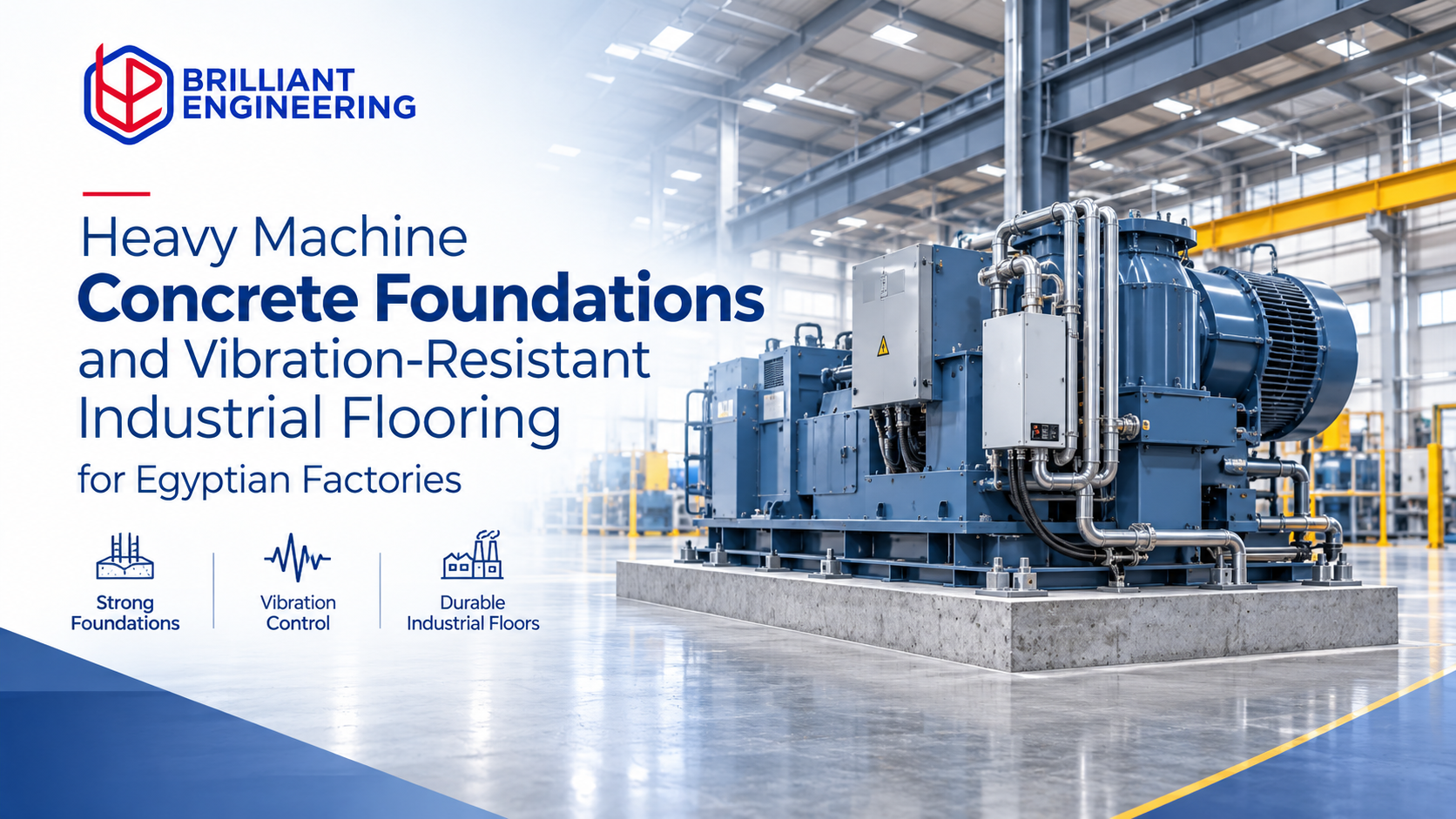
Heavy Machine Concrete Foundations and Vibration-Resistant Industrial Flooring for Egyptian Factories
A machine that vibrates on a poorly designed foundation damages itself, the floor beneath it, and the products it makes. For plant managers and project engineers, industrial civil works in Egypt are not background work: the foundation decides how long equipment holds its alignment, how much maintenance it needs, and whether production meets tolerance.
Brilliant Engineering is a civil engineering contractor in 6th of October that builds machine foundations and industrial floors for factories across 6th of October, 10th of Ramadan, Obour, and Sadat City.
Why Heavy Machine Concrete Foundations Fail
Most foundation problems trace back to decisions made before the first pour:
- No geotechnical data. Designing without a soil report means guessing bearing capacity and settlement.
- Foundation shared with the floor slab. Vibration travels through a continuous slab into neighboring equipment and the building frame.
- Resonance. If the natural frequency of the foundation is close to the machine's operating frequency, vibration amplifies instead of damping.
- Weak anchor bolt zones. Poorly set anchors loosen under cyclic load and lose alignment.
Design Principles for Heavy Machine Concrete Foundations
Start with the manufacturer's data
The machine supplier provides static weight, dynamic forces, operating speed, and anchor layout. These inputs drive the foundation design. Ask for them before engineering starts, not after.
Mass and stiffness
A common rule for rotating and reciprocating equipment is that the foundation mass should be a multiple of the machine mass. The exact ratio depends on machine type and dynamic load, and is set by the design engineer rather than by a fixed rule of thumb.
Isolate from the main slab
Heavy machines should sit on an isolated foundation block, separated from the floor slab by a joint filled with compressible material. This keeps vibration from spreading across the plant.
Reinforcement and concrete
- Reinforced concrete sized for the dynamic load case, not just static weight
- Reinforcement detailed for fatigue, with adequate cover and lap lengths
- Low-shrinkage mix, properly cured, to limit cracking
- Embedded anchor bolts or sleeves positioned with templates and checked before the pour
Vibration-Resistant Industrial Flooring
A factory floor carries forklifts, pallet jacks, racking, and process equipment at the same time. A vibration-resistant floor design addresses:
Reinforced concrete slabs for factories
Slab thickness, reinforcement, and sub-base are selected from the actual load schedule: point loads from racking, wheel loads from forklifts, and dynamic loads from machines.
Joint layout
Contraction, construction, and isolation joints are planned on the drawings. Random cracking usually means the joint layout was ignored or poorly executed.
Surface finish
- Power-floated, dry-shake hardener finish for abrasion resistance
- Epoxy or polyurethane coatings where chemicals, hygiene, or dust control matter
- Flatness tolerance specified for narrow-aisle and automated handling equipment
Execution Checklist for Plant Managers
| Stage | What to verify |
|---|---|
| Site investigation | Soil report and bearing capacity confirmed |
| Design | Machine supplier data received and reflected in drawings |
| Formwork and rebar | Cover, spacing, and anchor positions checked before the pour |
| Concrete | Mix design approved, cube samples taken and tested |
| Curing | Curing method and duration documented |
| Handover | Level, alignment, and surface tolerances measured |
Doing the Work Under Production Pressure
Civil works for an operating factory often happen close to live production. Planning matters: phased pours, protected access routes, dust control, and coordination with MEP trades so that trenches, sleeves, and embeds are installed in the right order.
For new plants, turnkey factory construction in Egypt brings the foundations, structure, MEP, and finishing under one responsible contractor, which removes the gaps between trades that cause rework.
Frequently Asked Questions
How long does it take to build a machine foundation?
It depends on size and curing requirements. Most of the time goes to formwork, reinforcement, and curing rather than the pour itself. A realistic schedule should be agreed once the machine data and soil report are available.
Can a new machine be installed on an existing floor?
Sometimes, but only after checking slab thickness, reinforcement, and the machine's dynamic loads. Heavy or vibrating equipment usually needs a dedicated isolated foundation block cut into the existing slab.
Do we need a soil investigation for every project?
For heavy machines and new buildings, yes. Without it, bearing capacity and settlement are assumptions, and the risk lands on the owner.
Can you work in all industrial zones?
Yes. We work in 6th of October, 10th of Ramadan, Obour, and Sadat City.
Get a Quote for Your Industrial Civil Works
Brilliant Engineering handles design, execution, and handover of machine foundations and industrial floors. See our industrial civil works service or contact us to request a quote.