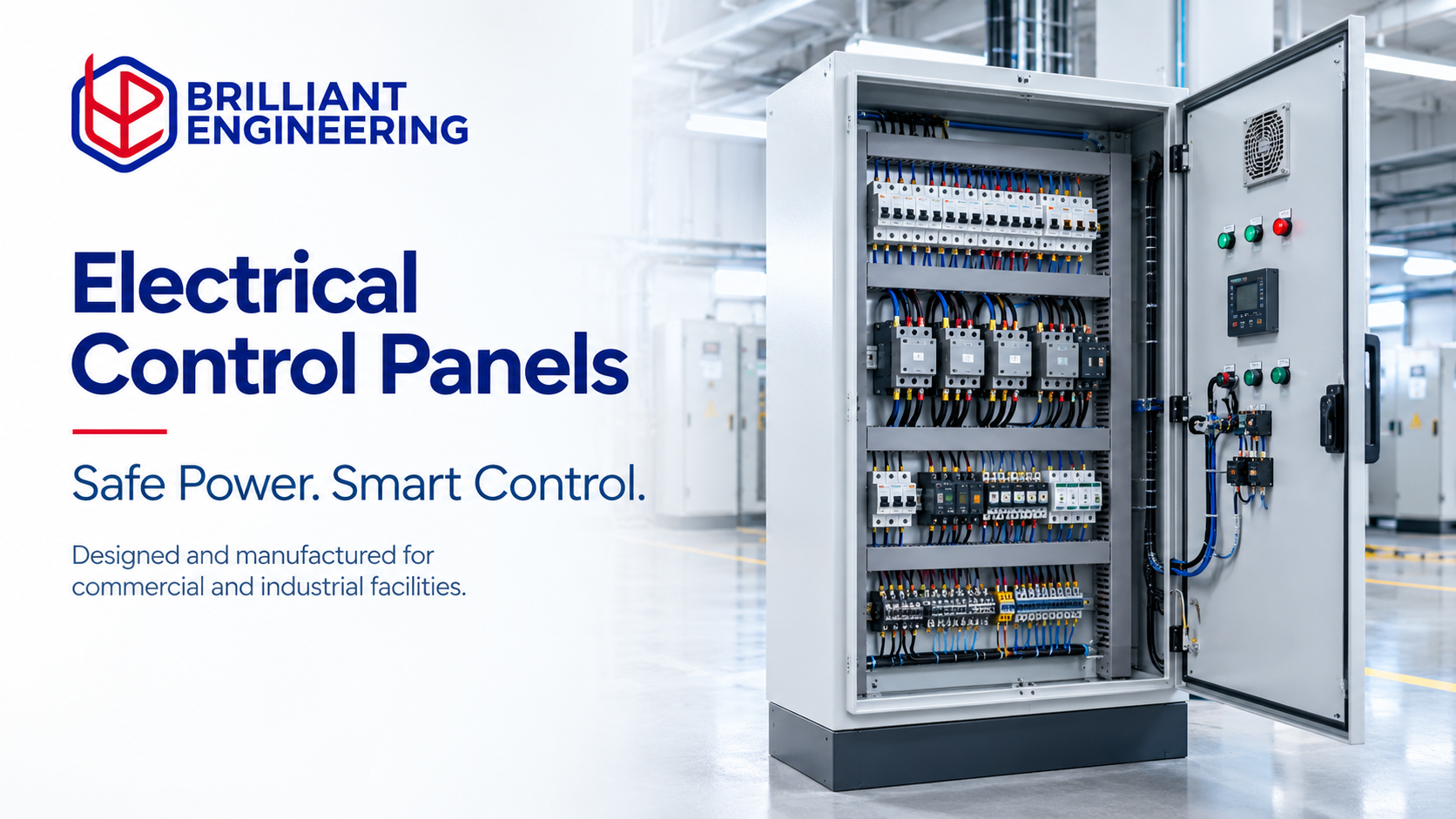
An electrical control panel is the nerve center of any building's power system. It receives electrical power from the utility supply, distributes it safely to every circuit in the building, and protects equipment and people from electrical faults. Without a properly designed control panel, no commercial or industrial facility can operate safely or efficiently.
At Brilliant Engineering, we design, manufacture, and install custom electrical control panels for commercial and industrial facilities across Egypt — from simple distribution boards to complex automated control systems.
What Is an Electrical Control Panel?
An electrical control panel is an enclosure that houses the electrical components responsible for controlling and distributing power throughout a building or facility. It serves three primary functions:
- Power Distribution: Receives incoming power and distributes it to individual circuits throughout the building
- Protection: Contains circuit breakers and fuses that automatically disconnect circuits in case of overload, short circuit, or fault
- Control: Houses contactors, relays, timers, and PLCs that control the operation of motors, pumps, HVAC systems, and other equipment
Types of Electrical Control Panels
1. Main Distribution Boards (MDB)
The primary panel that receives power from the utility transformer or generator and distributes it to sub-distribution boards throughout the building. Every commercial and industrial building has at least one MDB.
2. Sub-Distribution Boards (SDB)
Secondary panels fed from the MDB that distribute power to specific floors, zones, or systems within the building. Large facilities may have dozens of SDBs.
3. Motor Control Centers (MCC)
Specialized panels that control and protect electric motors — pumps, fans, compressors, and conveyor systems. Include motor starters, variable frequency drives (VFDs), and protection relays.
4. HVAC Control Panels
Dedicated panels that control all HVAC equipment — air handling units, chillers, cooling towers, and ventilation fans. Often include Building Management System (BMS) integration.
5. Fire Alarm and Emergency Panels
Control panels dedicated to fire detection, alarm, and suppression systems. Must comply with Civil Defense requirements and NFPA standards.
6. Generator and UPS Panels
Automatic transfer switch (ATS) panels that seamlessly switch between utility power and backup generator or UPS power during outages.
7. Lighting Control Panels
Panels that control interior and exterior lighting systems — including time switches, occupancy sensors, and dimming controls.
8. Automation and PLC Panels
Advanced control panels incorporating Programmable Logic Controllers (PLCs) for automated process control in factories and industrial facilities.
Key Components Inside a Control Panel
Circuit Breakers: Automatically disconnect circuits when they detect overload or short circuit conditions. Available in miniature (MCB), molded case (MCCB), and air circuit breaker (ACB) types for different current ratings.
Busbars: Copper or aluminum bars that carry incoming power and distribute it to circuit breakers. Must be sized for the full panel current capacity.
Contactors and Relays: Electromagnetic switches that control the operation of motors and other high-current loads. Controlled by lower-voltage control circuits.
Variable Frequency Drives (VFDs): Electronic devices that control motor speed by varying the frequency of the power supply — dramatically reducing energy consumption in pumps and fans.
Protection Relays: Intelligent devices that monitor current, voltage, and frequency — automatically disconnecting circuits when abnormal conditions are detected.
Energy Meters: Measure and record electrical consumption — essential for energy management and billing in multi-tenant buildings.
Surge Protection Devices (SPDs): Protect sensitive equipment from voltage spikes caused by lightning strikes or switching operations.
PLC and HMI: Programmable Logic Controllers and Human-Machine Interfaces provide automated control and monitoring of complex industrial processes.
How Are Control Panels Designed?
A properly engineered control panel follows a structured design process:
Step 1 — Load Analysis: Calculate all electrical loads in the facility — lighting, power outlets, HVAC equipment, motors, and special systems. This determines the incoming supply capacity required.
Step 2 — Single Line Diagram: Prepare a single line diagram showing the complete electrical distribution system — from the utility connection through the MDB, SDBs, and all sub-circuits.
Step 3 — Equipment Selection: Select circuit breakers, busbars, contactors, and protection devices sized correctly for each circuit's load and fault level.
Step 4 — Panel Layout Design: Prepare detailed panel layout drawings showing the position of every component inside the panel enclosure — ensuring safe access for maintenance and compliance with clearance requirements.
Step 5 — Manufacturing: Panels are manufactured in a workshop environment — cutting, drilling, and assembling the enclosure, mounting components, and wiring all connections according to the approved drawings.
Step 6 — Factory Testing: Every panel is fully tested before leaving the workshop — insulation resistance tests, functional tests of all circuits, and verification of protection device settings.
Step 7 — Site Installation and Commissioning: Panels are installed on site, connected to the building's cable network, and commissioned — with final functional testing and handover documentation.
Why Proper Panel Design Matters
A control panel that is incorrectly designed or manufactured creates serious risks:
Fire Hazards: Undersized cables and busbars overheat and can cause fires. Incorrectly rated circuit breakers fail to protect circuits.
Equipment Damage: Incorrect protection relay settings allow fault currents to flow for too long, destroying motors and other equipment.
Downtime: Poor quality components and connections cause unexpected failures — shutting down production lines or critical systems at the worst possible time.
Regulatory Non-Compliance: Panels that do not meet Egyptian Electricity Authority (EEA) and international standards fail inspection and cannot be energized.
Safety Risks: Exposed live parts, inadequate earthing, and missing arc flash protection put maintenance personnel at serious risk.
Egyptian Electrical Standards and Requirements
All electrical control panels installed in Egypt must comply with:
- Egyptian Electricity Authority (EEA) regulations for utility connections and metering
- IEC 61439 — the international standard for low-voltage switchgear and control gear assemblies
- Egyptian Building Code electrical requirements
- Civil Defense requirements for emergency and fire alarm panels
Brilliant Engineering designs and manufactures all panels to these standards — with complete documentation for authority approval.
Why Choose Brilliant Engineering for Your Control Panels?
Brilliant Engineering designs and manufactures custom electrical control panels in our dedicated workshop — ensuring quality control at every stage from design through delivery.
Our control panel capabilities include:
- Main Distribution Boards (MDB) — up to 6300A incoming capacity
- Sub-Distribution Boards (SDB) — for all building zones and floors
- Motor Control Centers (MCC) — with VFDs, soft starters, and protection relays
- HVAC Control Panels — with BMS integration
- Generator ATS Panels — automatic transfer with load shedding
- PLC and Automation Panels — for industrial process control
- Custom Enclosures — IP54 to IP65 rated for outdoor and harsh environments
Every panel includes complete engineering drawings, factory test certificates, and operation and maintenance manuals.
Ready to discuss your electrical control panel requirements? Contact Brilliant Engineering today for a free technical consultation.